
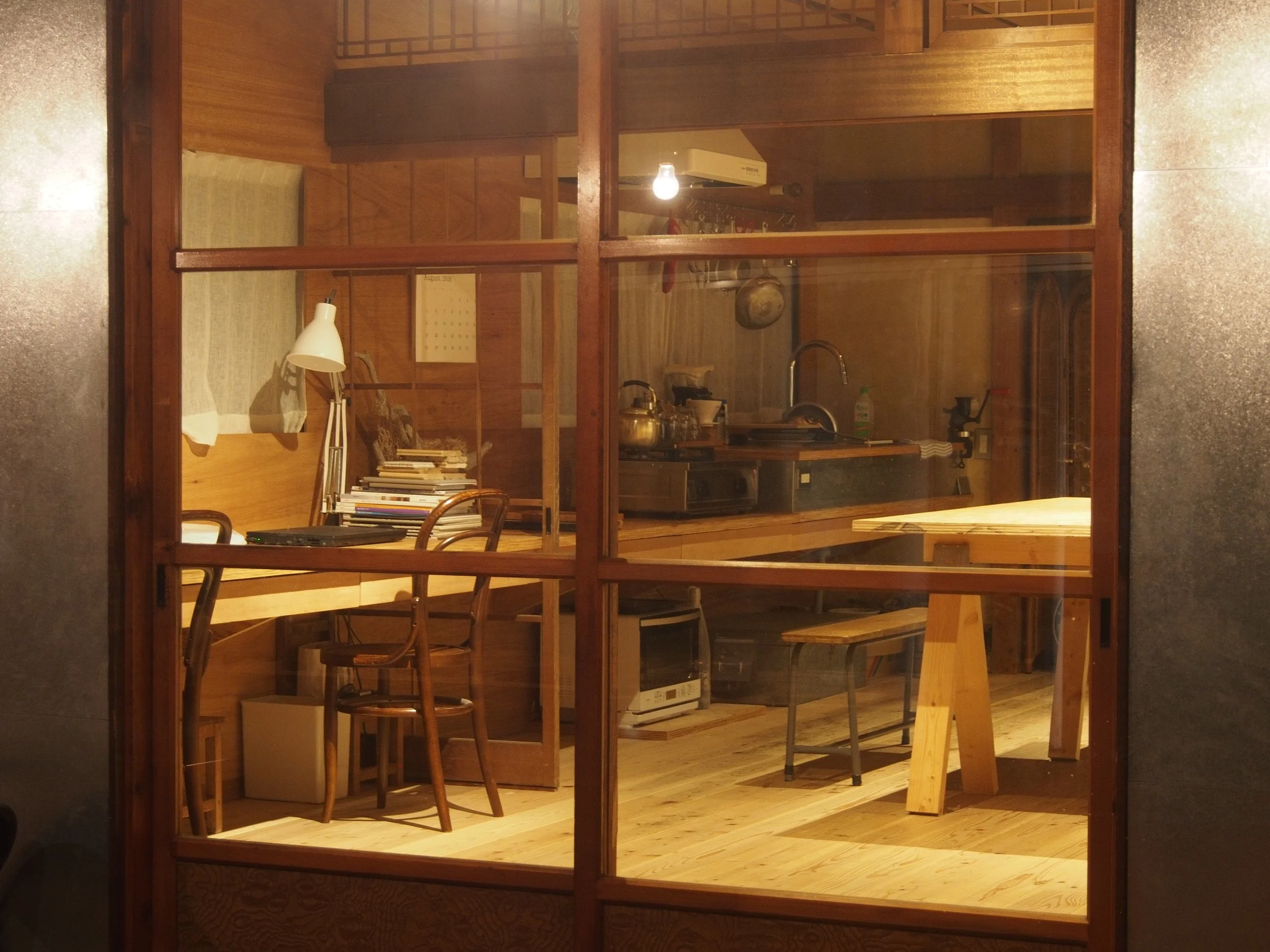
Perception of Home
ESSAY
-
How does material culture shape our perception of ‘home’?
-
What is home? The house and the home
The body Experiencing space through the senses
Belonging Developing a sense of home
Place Where is ‘home’?
Time Impermanence and changing meaning
Experience Phenomenology and architecture
Memory How places stay with us
Objects Material culture and belonging
The contradiction Farnsworth House and the limits of architecture
Home What makes somewhere feel like home?
-
Written on May 2017
I wonder, is home something we inhabit, something we possess, or something we continually construct through memory, relationships, the body, and experience?
What is home?
A space becomes a place when it is defined by its use. When space has the purpose of sheltering someone, when it becomes a place where one lives, it is sometimes described as ‘home’. But what makes a space feel like home is less straightforward. Is home the physical space itself, or is it the relationship we develop with it?
How do we experience home? How true is the idea that home is associated with warmth and safety? What impact do the senses have on the feeling of home? How does the body perceive the physical object that is home through the senses? How does architecture affect our perception of home? Where is ‘home’? Does the sense of home change? How are memories linked to the feeling of home? Is home defined by our belongings? And ultimately, what is the purpose of a home?
This essay attempts to find an answer to these questions by analysing the meaning of ‘home’ and the relationship between material culture and people’s perceptions of home, taking Mies van der Rohe’s Farnsworth House as a case study.
The Farnsworth House presents an interesting contradiction. It was designed as a house, with the intention of becoming a home, and has since become an iconic piece of architecture. Yet its inhabitant, Edith Farnsworth, did not find it satisfactory as a home. This raises a fundamental question: can architecture design a home, or can it only create the conditions in which a sense of home develops?
The house and the home
Ludwig Mies van der Rohe was born in Germany in 1886 and died in 1969. He is one of the most influential architects of the twentieth century, known for his role in the development of one of the most enduring architectural styles of the era: modernism. His modernist architecture has remained influential for almost a century, with the Barcelona Pavilion, designed for the 1929 International Exposition, being one of his most famous works.
In 1945, Mies van der Rohe was asked to design a house in Plano, Illinois, for his client Dr Edith Farnsworth. The house was completed in 1951 and has since become an iconic building, now owned by the National Trust for Historic Preservation.
The house’s glass walls and openness create a strong relationship with the surrounding nature, but they also question the traditional understanding of what a home should be. While home is defined as “the place or a place where one lives”, that could be “a house or other dwelling”, home is also a subjective concept that refers to the feeling of belonging one has, or develops, in a certain place.
Perceptions associated with this feeling of belonging are different for each individual because they are built through the experiences we have in life. A house can therefore provide the physical conditions for living without necessarily becoming a home.
One common preconceived idea regarding the notion of ‘home’ is that it has warmth, intimacy, safety and beauty. This notion can be found in Gaston Bachelard’s idea of the ‘felicitous space’. In The Poetics of Space (1969), he describes the house as follows:
“…our house is our corner of the world. … If we look at it intimately, the humblest dwelling has beauty…”
My understanding of this is that we take root in a vital space where our aesthetic senses are satisfied. Making our home aesthetically pleasing is possibly a goal most of us share, a traditional notion that many of us carry.
There is also the idea of ownership in Bachelard’s “our corner of the world”. The home becomes an intimate and safe place because it becomes ours. Through inhabiting it, we develop a relationship with it and give it meaning.
Mies designed a house intended to become the client’s home, but which ran counter to many of these traditional ideas. The relationship with this glass house is different from the preconceived idea of the traditional home. It is transparent rather than enclosed, open rather than intimate, and minimal rather than filled with the signs of everyday life.
The Farnsworth House therefore becomes a useful case study because it questions whether the physical qualities of a house are enough to create the emotional qualities we associate with home.
The body and the experience of space
How does that encounter between a person and their own space happen?
We use our bodies to sense our environment. When the body encounters a space, it experiences it in a way that creates a unique perception. The sense of touch, amongst others, enables one to understand a physical space:
“the skin reads the texture, weight, density and temperature of matter”.
Much information is taken in to build our perception. The experience of space does not happen only through looking at it. It happens through the whole body.
There is a strong identity between naked skin and the sensation of home. One might imagine that a primitive human, in the sense of a person belonging to a non-industrial society or culture, naked in the forest, shows how much nature can give a feeling of home. The body encounters temperature, texture, sound, smell and light before consciously understanding the environment as a place.
In Farnsworth’s house, the relationship between the body and the architecture extends to the outdoors through a discreet use of materials such as glass. The encounter is uniquely subtle. The physical boundaries of the house are present, but they do not completely separate the body from the surrounding landscape.
The house creates a condition in which the inhabitant can feel protected while remaining exposed to nature. This creates an unusual relationship between shelter and openness.
An informal survey I conducted showed that home is usually associated with the idea of a familiar place creating a sentimental attachment. The idea is that a home should provide comfort, security or shelter, privacy and intimacy. It helps the dweller to identify with their surroundings, to connect, whether consciously or unconsciously, and develop an awareness through the body’s sensory experience.
Farnsworth’s house was designed to create a relationship with its surroundings. It is a free and open space allowing the client to create a sentimental attachment with nature, using the house as an interface, while at the same time giving a feeling of being secure due to the presence of physical boundaries.
The architecture can therefore create the possibility of home, but it cannot guarantee the feeling of home.
Developing a sense of home
These interactions and interrelations between the body and the surroundings are what develop a sense of place. Specific use and relationship will define the place as a ‘home’.
Home is where rituals take place as part of our everyday experience. Eating, sleeping, reading, resting, talking, arguing, storing objects and creating memories are all activities that gradually give meaning to a space.
“These relationships are home for me,” said Taiye Selasi at a conference. This suggests that home does not necessarily have to be understood as a geographical location. It can be created through relationships and experiences.
What are these relationships built by the architectural space?
The conception of Mies van der Rohe’s Farnsworth House leads to a love triangle between the architect, the client and the house, which developed during the design and construction of the building. Mies and Farnsworth socialised between 1947 and 1950 and had many conversations about architecture, philosophy and life.
The relationship between the two therefore became part of the meaning of the house. The house becomes a place for connections to happen. It becomes a catalyst for conversations and experiences that could not be separated from the architecture itself.
The building was no longer simply an object. It became part of a relationship. This leads to another question: does a building become a home because of what it is, or because of what happens there?
Where is ‘home’?
“How can a human being come from a concept?”
Finding home is part of the process of forming an individual’s identity. A home represents one’s personality and helps one build one’s identity.
“People make places in which to do the things they do in their lives — place to eat, to sleep, to worship, to argue, to learn, to store, and so on and on.”
In the same way, for three years of their lives, Mies van der Rohe and Edith Farnsworth used the house as a catalyst for conversations about life. Does this mean the house had to be a home for both of them during that period of their lives?
“My experience is where I’m from” says Selasi in a conference.
Home does not have to be linked to something physical because of the time spent there. Home can be a feeling that one gets from a place, a sensation, or an object. The idea that this sensation has to be linked to a permanent physical place may be associated with the need for a sense of being in this world.
Material culture such as architecture is there to give individuals “a sense of being in the world”. It has the ability to give a feeling of existence but also to give an illusion of being protected. It gives a sense of scale that allows the human being to feel alive.
“We identify ourselves with this space, this place, this moment, and these dimensions become ingredients of our very existence.”
The comfort of knowing the limits and being able to control them, and the life you create for yourself, is reassuring. It adds purpose to one’s life.
The fundamental purpose of architecture is “the conceptual organisation, and identification of place”.
The feeling of home has a temporary nature. Its impermanence is triggered by the many experiences of life, changing our perception of reality. A place that once felt like home may no longer feel the same when we return to it.
Impermanence
Franz Schulze, author of the Mies van der Rohe critical biography in 1985, states in the 1997 monograph on Farnsworth House that the personal relationship between Edith Farnsworth and Mies van der Rohe is “inseparable from the history of the house”.
This relationship, as well as anything that happened in the house, gave meaning to it and made it become Edith Farnsworth’s house and not just a physical piece of architecture.
With time, the meaning of the house changed. The house that had once been connected to the relationship between Mies and Farnsworth became something different. The people entering the house have different life experiences, different identities and different perceptions.
This makes the focus of attention shift from one thing to another, making the meaning of the place evolve with time.
Can an unconditional home exist when time modifies memories, perception and identities? Can a home you have created for yourself stay a home forever?
Old sights, such as a home, will always evolve and become something different. ‘Home’ is not just a place where you were born or a place where you live. Home is “the place where you become yourself”.
To ‘become’ is to evolve.
Life is about change. Physical objects change with time, but so do our relationships with those objects. The process of home becoming your own place involves this relationship between the physical and the emotional, whether in the same geographical place or not.
Home becomes your future, a place where life events will take place.
“Like language, architecture is not stagnant. Both language and architecture (as identification of place) exist through use, and are subject to historical changes and cultural variation.”
Time is an unlimited progression of existence and experiences, giving us more purpose to life through change.
Phenomenology
“The phenomenology of architecture is ‘looking at’ architecture with its consciousness experiencing it.”
For the philosopher Edmund Husserl, the philosophical movement of phenomenology intends to discover the basis of consciousness and experience. He describes this concept as “pure looking at” or as “viewing its essence”, meaning the phenomenon, the things we perceive, exists through our senses.
Phenomenology is a sensorial discovery of the built environment, a unique experience that cannot be perceived in exactly the same way because of its extreme subjectivity.
In the architectural context, it is the unique perception of the atmosphere created by the physical space.
It “is founded on verbs rather than nouns.”
Verbs are used to depict action or emotion, while nouns are used to refer to objects, persons and material things. Architecture uses space, light and materials to trigger different feelings and behaviours.
This distinction is particularly interesting when thinking about home. A house is a physical object. Home is something that happens through inhabiting.
The philosopher Martin Heidegger attempted to understand the meaning of being with a phenomenological approach, looking at poetry, architecture and technology.
Is the experience of architecture different from the experience of other arts, such as painting, poetry or sculpture?
In Ways of Seeing (1972), John Berger questions some of the assumptions made about the tradition of European painting and the way we see these paintings now, in the twentieth century, because “we see these paintings as nobody saw them before”.
“If we discover why this is so, we shall discover something about ourselves and the situation in which we are living.”
Looking at a piece of art in the context of our own life is very different from someone else’s life context. The way we see a piece of art is constantly connected to its environment and influenced by it.
“Once these paintings belonged to their own place.”
“Everything around [a piece of art] confirms and consolidate its meaning.”
“The image of the painting is travelling now.”
The same can be said for architecture. When, where and what we see will lead to different meanings of that same architecture.
The Farnsworth House is an example of this. When it was first built, it was a controversial modernist house connected to a particular client, architect and relationship. Today, it is also seen through the history of modern architecture and as an iconic cultural object.
The physical house has not fundamentally changed, but the way it is understood has.
Memory
In 1951, towards the end of a year of construction, Edith Farnsworth attempted to sue Mies van der Rohe for a cost overrun of $15,600, with the total cost of the house being approximately $74,000. An unconfirmed rumour was that this happened after the end of a relationship.
After Mies van der Rohe won the case, Edith Farnsworth used the house as her retreat for the following 21 years of her life.
At the time of Edith Farnsworth’s lawsuit, the glass house was highly criticised, in particular by the well-known interior architecture magazine House Beautiful. Today, it has become a famous and iconic piece of architecture.
The meaning of the house therefore changed with time, as did the relationship between the house and its inhabitant.
“The resurrected space of the bedroom is enough to bring back to life, to recall, to revive memories.”
George Perec suggests here that a physical space or object has the potential to recreate a feeling previously experienced.
Memories are associated with the feelings of architecture but not the architectural objects themselves. The feeling of home can work in the same way, so that it is not the object itself but the feelings triggered by the architecture or elements of a place that give the feeling of home somewhere new.
How can concrete materials used in architecture create a sense of home?
The smell of wood can revive memories that make you feel at home, or the contact of feet on a cold tiled floor. A sound, a texture, a temperature or even a particular quality of light can make us recall a space or object.
Can a sense of home be applied to any material culture if all the conditions for this feeling to arise are met? Can even just one element make you recall a space or object?
The body is able to trace and experience the space it is in, with unerring precision. The knowledge and memory of the body’s experience allows us to recreate, feel again, this atmosphere in another place.
“An impressive architectural experience sensitises our whole physical and mental receptivity.”
Designing a home with a sense of place can maximise meaning and memory of place, increase sensory pleasure by heightening the five human senses.
“Architecture represents identity and memory.”
What is ‘material culture’?
Material culture is a notion used in sociology to describe the physical objects or spaces used by people to define their culture, a way of life defined by beliefs, knowledge and behaviour.
Material culture is made up of the physical objects that take part in our way of life. Materialising the way of life helps individuals feel they belong, exist and matter.
Most of the objects used in everyday life are owned by the person using them. Those belongings go towards making us feel, in a way, at home. The meaning of home is affected by the possessions we keep there.
Home is a place where objects are collected with time. Objects are stored as one of the ways to be able to memorise the events in our lives, and they help us to feel purposeful.
Frank Mascia says:
“we are living our life depending on the space we’ve got rather than creating our space to fit our lives.”
It is said that modern architecture theory and critique have had a strong tendency to regard space as an immaterial object. Modern architecture has indeed a minimalist approach.
“Less is more” is the motto used by Mies van der Rohe. He described his buildings as a “skin and bones” architecture and a “glass box residence”.
Should home be defined by the belongings or by the phenomenology of architecture?
Maybe we do not need belongings provided we take possession of a place and make it our own.
Edith Farnsworth’s house became her possession, an expensive possession, where she was to spend her weekends for 20 years. But possession and belonging are not necessarily the same thing.
Interestingly, the concept of ‘homelessness’ is related to the lack of physical object or space as your own.
“A homeless person is someone who does not have access to accommodation which they can reasonably occupy.”
The concept of homelessness is defined purely as something physically lacking, whereas having a home can be very abstract and poetic in the sense that it is about the feelings associated with space that defines home.
Why is there such a difference?
One wonders whether someone who does not have any accommodation can feel at home in any way in this world today. It could be argued that home is not material but emotional, that it relates to people and their presence.
If we have our senses to connect with our environment, is material culture necessary to create a sense of home?
Maritz Vandenburg has written in a monograph on the Farnsworth House:
“Every physical element has been distilled to its irreducible essence. The interior is unprecedentedly transparent to the surrounding site, and also unprecedentedly uncluttered in itself. All of the paraphernalia of traditional living — rooms, walls, doors, interior trim, loose furniture, pictures on walls, even personal possessions — have been virtually abolished in a puritanical vision of simplified, transcendental existence.”
The house becomes the most important possession for the existence of the person, giving a sense of purpose, a feeling of safety, a sense of peace.
But if the house itself is the possession, does the absence of other possessions matter?
The Farnsworth House challenges the relationship between home and material culture. It removes many of the objects traditionally associated with domestic life, but at the same time it creates an architecture so distinctive that the building itself becomes the dominant object.
Perhaps the question is therefore not whether objects are necessary for home, but whether we need to be able to make something our own.
The contradiction between architecture and home
An example of the contradiction between architecture and home is shown in the Farnsworth House court case between Mies van der Rohe and his client, Edith Farnsworth.
“Mies had designed one of the most important and aesthetically appealing houses of our century, but his client did not find it satisfactory as a home.”
This case shows how the relationship that developed between the architecture, the architect and the client was not enough to satisfy Edith Farnsworth’s desire for a sense of home at that time.
The role of the house during their relationship was more significant than when it ended.
The building itself did not change, but the meaning of the building changed.
This is perhaps the most important contradiction of the Farnsworth House. Mies could design the physical conditions of the house, but he could not design how Farnsworth would ultimately experience it.
Architecture can control material, space, light, proportion and boundaries. It cannot completely control memory, relationships, identity or emotion.
A house can be designed.
A home has to be experienced.
How does material culture shape our perception of ‘home’?
The traditional idea of home is that home is a cosy space for one to rest. However, in reality, our way of life has changed. We have developed a new relationship with our environment and material culture, while keeping the ability to sense things and our unique relationship with reality.
We may feel that our home is built from relationships, moments and sensory experiences.
The quest for a home helps to form one’s personality. Home is part of the process of our life and architecture helps people develop a sense of home.
Home is different to every person.
What Mies van der Rohe thought would be a home for Edith Farnsworth ended in discontent concerning the design of the house. Although beautifully expressing the architect’s vision, it failed to satisfy the needs of the client.
“In my view, the task of architecture is to make visible how the world touches us,” says Merleau-Ponty.
The house as a physical object fails as a home if it is not experienced as such by the individual for whom it was built.
“My experience is where I’m from,” says Selasi.
My home will change from place to place, inhabiting different architectures and different atmospheres, helping me with different needs at different times of my life.
“We identify ourselves with this space, this place, this moment, and these dimensions become ingredients of our very existence.”
But does a human being really need material culture to be someone?
Mies van der Rohe started this minimalist style in architecture, with Edith Farnsworth’s house setting the example. Minimalism is now a movement as a way of life, a life in which the few necessary belongings are those which give a sense of belonging in this world.
Home gives to people a sense of belonging that can be both material and emotional.
What makes somewhere home?
Perhaps home is not a place we find, but a relationship we continually construct.
Architecture can provide shelter, boundaries, atmosphere and the possibility of belonging, but it cannot determine how a place will ultimately be experienced. The Farnsworth House makes this contradiction visible: Mies could design the conditions of a home, but he could not design the feeling of being at home.
Home is therefore less a physical object than an ongoing relationship between body, space, memory, objects and people.
It changes as we change.
A room can become home through the rituals that take place within it. An object can carry the memory of a place long after we have left it. A smell, a texture or a particular quality of light can transport us somewhere else. A building can remain architecturally significant while no longer being experienced as home by the person who inhabits it.
The meaning of home is therefore temporary and personal. It can appear in a place, disappear from it, and reappear somewhere else. It can be carried through objects, memories and relationships.
Home is not simply where we live. It is where we develop a sense of belonging, where our experiences become memories, and where our relationship with the world becomes part of who we are.
Perhaps the question is not simply what is home?, but what makes somewhere feel like it could be home to us?
This changes the role of design. Rather than designing a fixed idea of what a home should be, perhaps we should design for the possibility of attachment: creating spaces that allow people to experience, inhabit, remember and ultimately make a place their own.
A house can offer the conditions. But a home happens through living.
References
ArchDaily. (2015). Sex and Real Estate, Reconsidered: What Was the True Story Behind Mies van der Rohe's Farnsworth House?. [online] Available at: http://www.archdaily.com/769632/sex-and-real-estate reconsidered-what-was-the-true-story-behind-mies-van-der-rohes-farnsworth-house [Accessed 7 May 2017].
Archdaily.com. (2017). Mies Van Der Rohe | Tag | ArchDaily. [online] Available at: http://www.archdaily.com/ tag/mies-van-der-rohe [Accessed 7 May 2017].
Bachelard, G. (1969). The Poetics of Space. 1st ed.
Kurki, I. (n.d.). JUHANI PALLASMAA: IDENTITY, INTIMACY AND DOMICILE - Notes on the phenomenology of home. [online] Uiah.fi. Available at: http://www.uiah.fi/studies/history2/e_ident.htm [Accessed 7 May 2017].
'Minimalism: A Documentary About the Important Things’. (2016). [film] Directed by M. D'Avella. USA. Pallasmaa, J. (1996). 'The Eyes of The Skin'. 1st ed.
Pallasmaa, J. (1996). 'The geometry of feeling : a look at the phenomenology of architecture'. 1st ed. Perec, G. (2008). 'Species of Space and Other Pieces. 1st ed.
Schulze, F. (1997). The Farnsworth House (Lohan Associates). p.12.
TED Talk by Pico Iyer : Where is Home?. (2013). [video] Directed by P. Iyer.
TED Talk by Taiye Selasi: Don't ask where I'm from, ask where I'm a local. (2015). [video] Directed by T. Taiye Selasi.
The European Commission - Employment, Social Affairs and Equal Opportunities (2007). Measurement of Homelessness at European Union Level. p.56.
Unwin, S. (2010). Analysing architecture. 1st ed. London: Routledge.
Ways of Seeing. (1972). [video] Directed by J. Berger.
Wendl, N. (2015). Sex and Real Estate, Reconsidered: What Was the True Story Behind Mies van der Rohe's Farnsworth House?. [online] ArchDaily. Available at: http://www.archdaily.com/769632/sex-and-real estate-reconsidered-what-was-the-true-story-behind-mies-van-der-rohes-farnsworth-house [Accessed 7 May 2017].